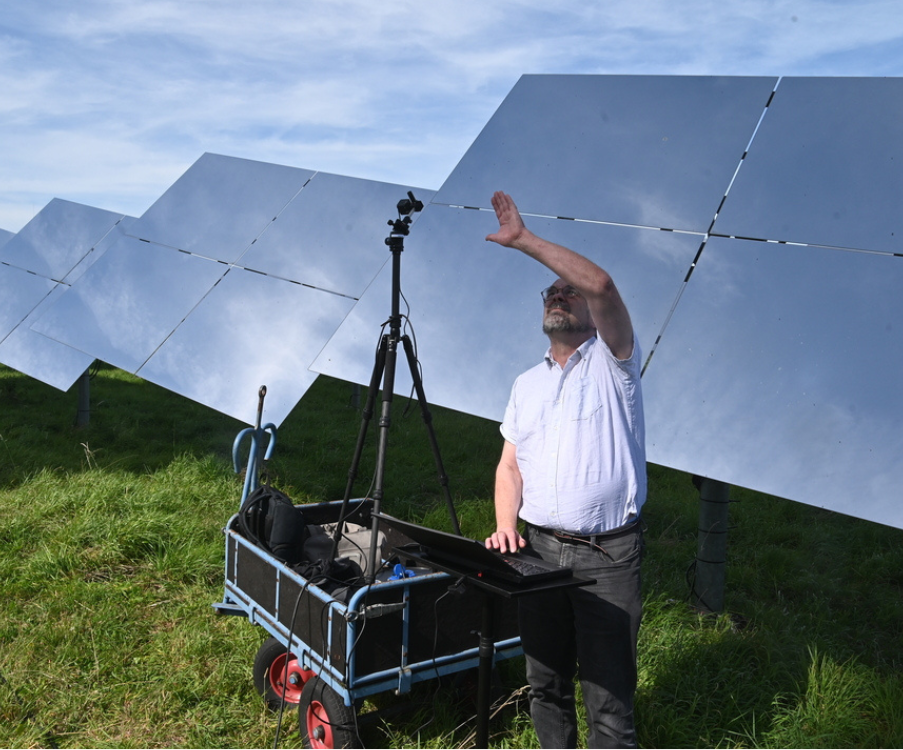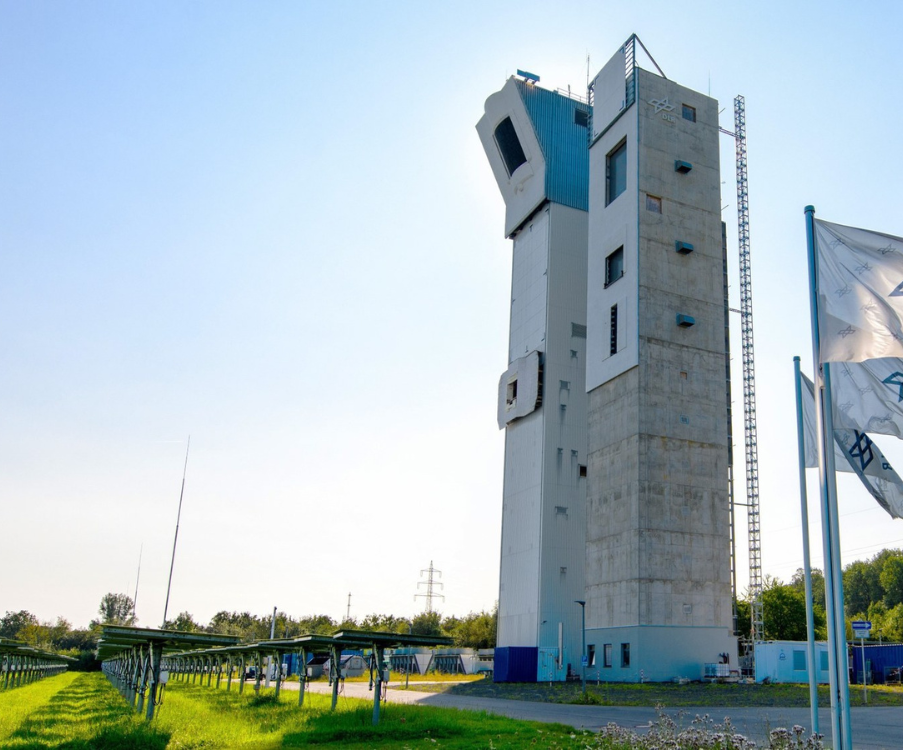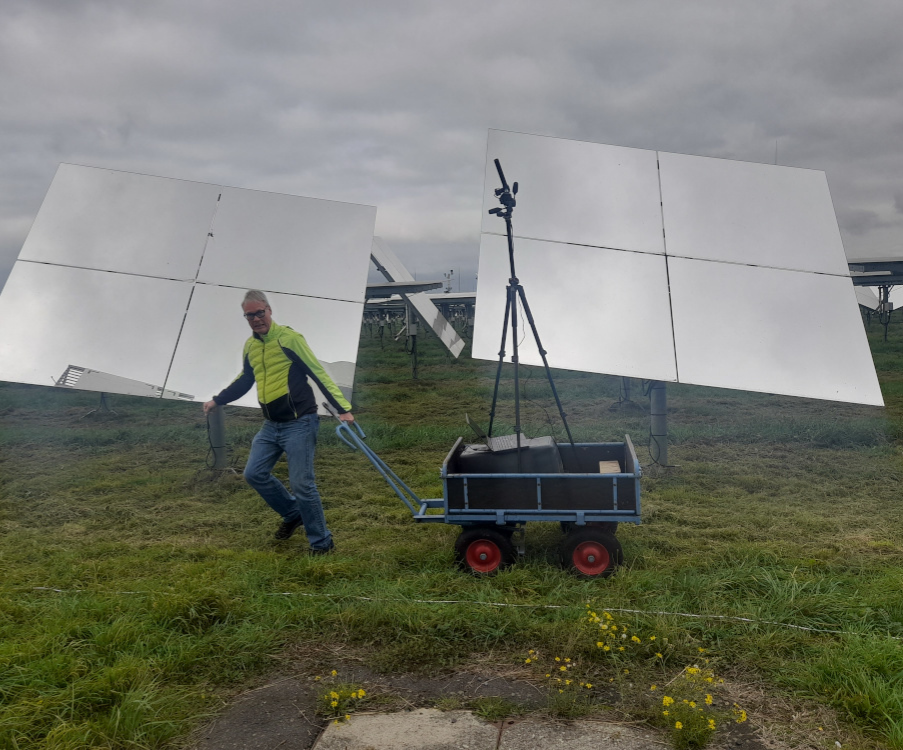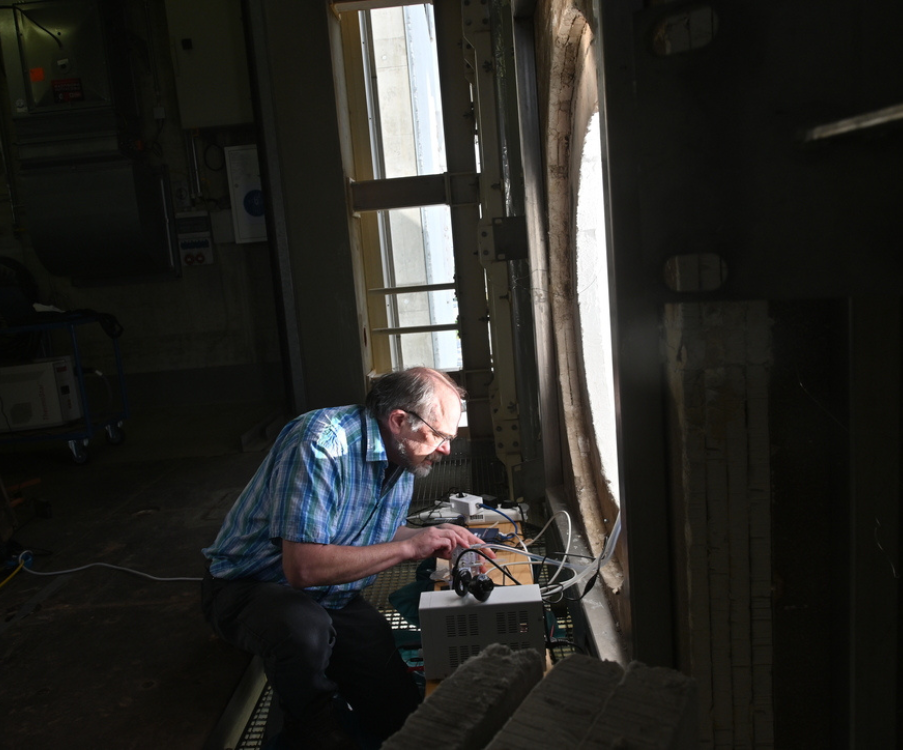
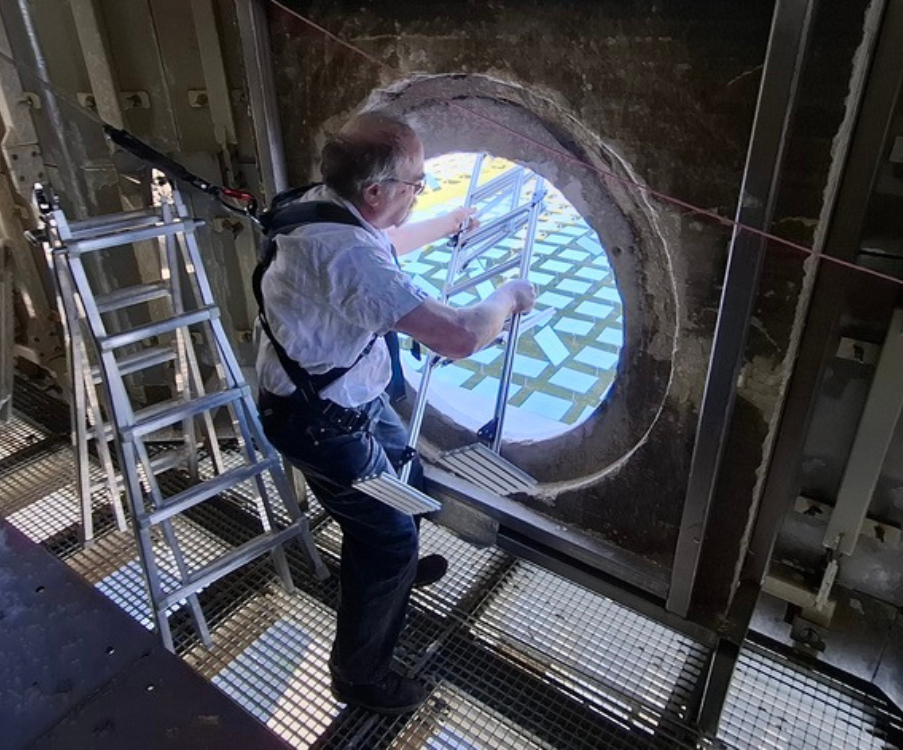
Dr. Bernhard Adams, physicist and CTO of Heliosync at the DLR solar tower facility in Jülich
Meet Dr. Bernhard Adams and Martin Adams, the father and son duo behind Heliosync, an Estonia-based company enabling cost-effective solar thermal applications. While Martin is bringing in the entrepreneurial drive by leading the business and commercial side of the company, Bernhard is bringing in the scientific expertise, being a physicist specialised in optics.
Heliosync focuses on concentrated solar power (CSP) systems — complex infrastructures where hundreds to thousands of mirrors must precisely reflect sunlight onto a central tower. Their aim is to develop and commercialise a minimum viable product (MVP) that improves the alignment of those mirrors to enable more precise targeting of sunlight onto the tower, a key factor for maximising efficiency and overall system performance. In addition, this improved alignment enables much less expensive heliostat construction by replacingmechanical rigidity with closed-loop control.
Through RISEnergy’s Transnational Access, they brought their innovation to the DLR Solar Tower Power Plant Jülich in Germany, where they were able to test their technology in real operating conditions.
“We needed access to a real-sized facility to test our product in that environment. Testing validates the legitimacy of our project, that it’s not just like a backyard project.”
-Martin Adams, CEO of Heliosync
The research challenge
Only 5% of global energy production comes from solar power. A number that is unacceptably low for Heliosync, who sees the sun as the most abundant and clean source of energy, whose potential is not sufficiently harnessed by current technologies. Their solution? A tracking system for CSP installations that provides precise heat maps, enabling optimal adjustments of the mirrors within seconds.
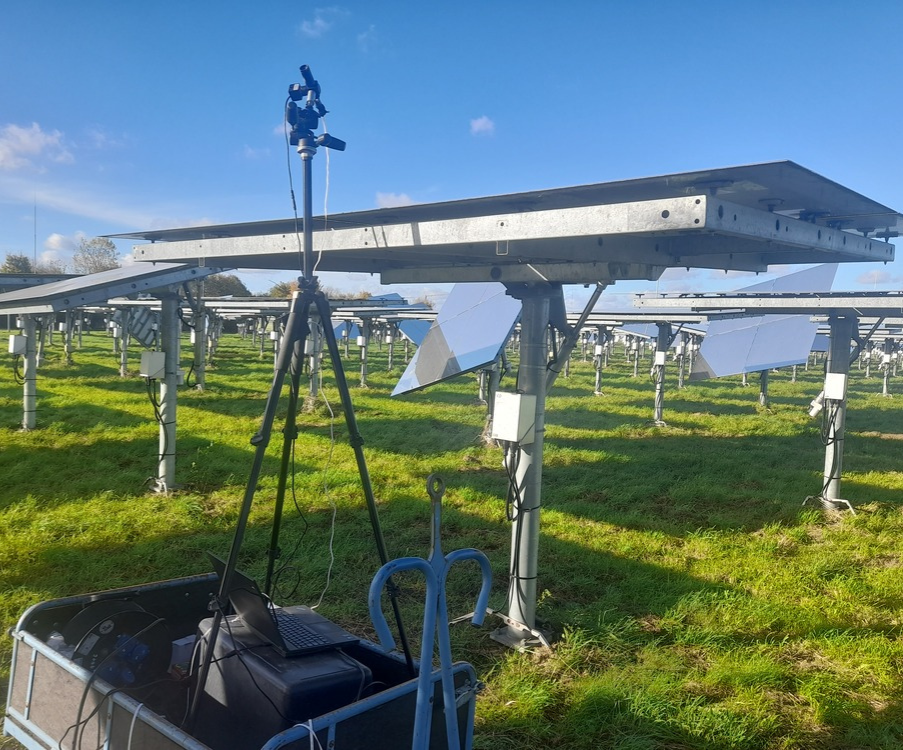
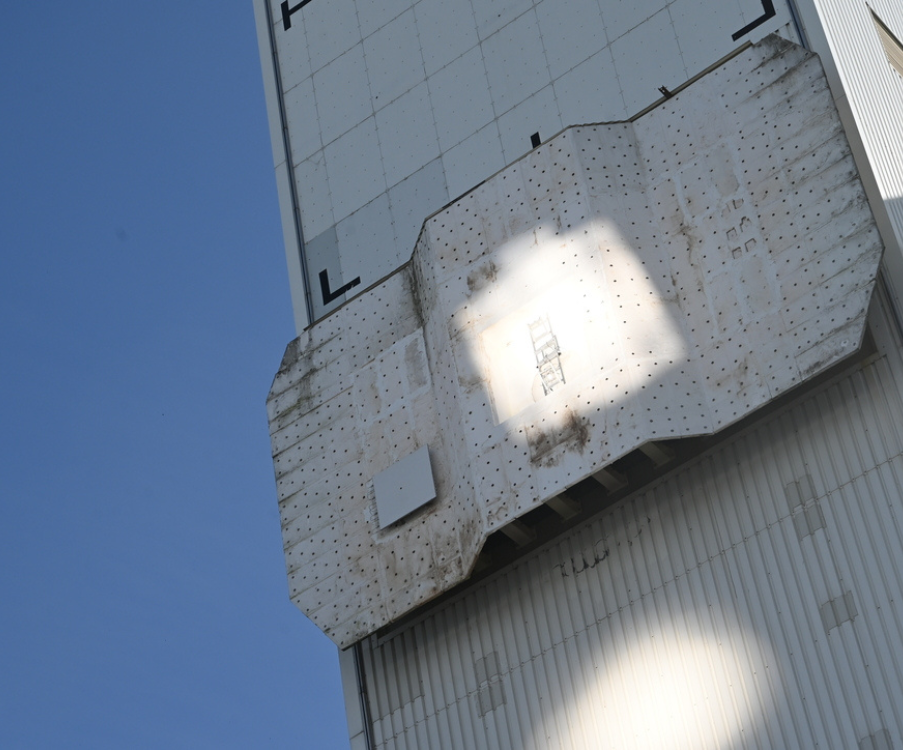
Their alignment system works with retro reflectors on the solar tower to return an optical signal to each heliostat for assessing its pointing. Retro- reflectors, commonly used, for example, in bicycle safety reflectors, reflect each light ray back to its respective origin, thus providing simultaneous and independent feedback information to each heliostat. The heliostats have attached photosensors which receive the signal from the retro-reflectors. Like many early-stage innovators, Heliosync started with a concept they knew would work in small-scale conditions, but questions remained: would this alignment system work in real industrial environments? How can they move their concept to market, and prove that it works on a real-life scale?
The step from concept to real-world validation is where many innovations slow down. Not because the idea is weak, but because access to large-scale infrastructure is limited, costly, and often out of reach for smaller companies. This is why Heliosync applied to RISEnergy: to gain access to a research infrastructure otherwise inaccessible to them.
Access to research infastrcuture
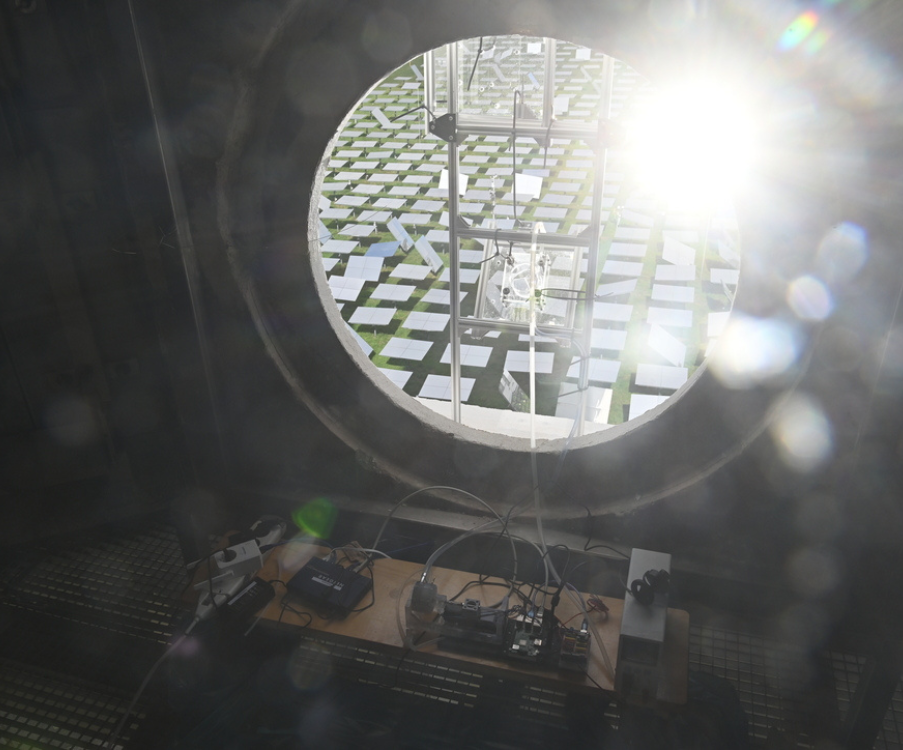
At the solar tower facility in Jülich, Heliosync moved from theory to reality. Instead of simulations and small prototypes, they worked directly within a full-scale CSP system.
On site, the team installed the retro-reflectors on the tower and set up a sensor on the heliostats to test whether alignment could be measured and improved in real conditions. Thanks to their work there, Bernhard and Martin were able to see how their technology worked in a real operating environment and receive expert support from the scientists on site. They confirmed that the alignment system can improve the accuracy of heliostat mirrors by around 30%, resulting in up to €30,000 per MW per year in additional thermal energy output. It reduces downtime and mirror calibration labour by up to 99%, enabling faster deployment and improved ROI for solar thermal facilities.
“We got some nice results; this access was instrumental for our product. We are now able to talk to customers and tell them that we tested our product. We can demonstrate it works in a real environment.”
– Dr. Bernhard Adams, Physicist and CTO of Heliosync


Impact on their research journey
For Heliosync, this marked a turning point. Moving from small-scale testing to a real facility not only generated valuable data for their future research but also strengthened the credibility of their technology.
“It validates the legitimacy of our project. It shows that we are not just testing ideas in a small setup, but that we can operate at scale and be serious players in this industry. In that sense, RISEnergy was a key enabler. Testing our product in Jülich was a crucial step on our way to continuing to develop it and bringing it to market.”
– Martin Adams, CEO of Heliosync
Access to Jülich marked Phase 1 of their plan — a stage focused on demonstrating the fundamental operation, ease of installation, scalability, and modularity at a real-scale facility, though not yet under full solar irradiation. The next step is testing in Spain, where sunnier conditions will allow them to build on and strengthen the Phase 1 results.
Being able to demonstrate performance in a real environment is essential to engage customers, attract investment, and move towards commercialisation. Access to the solar tower facility gave them the confidence and evidence needed to continue their work.
What is RISEnergy’s Transnational Access?
RISEnergy is an EU-funded project that connects researchers with leading energy research infrastructures across Europe and beyond. Through its Transnational Access (TA) programme, selected applicants can access these facilities free of charge to test, validate, and scale their technologies in real operating conditions. By removing barriers to infrastructure, RISEnergy helps bridge the gap between early-stage research and real-world application.