
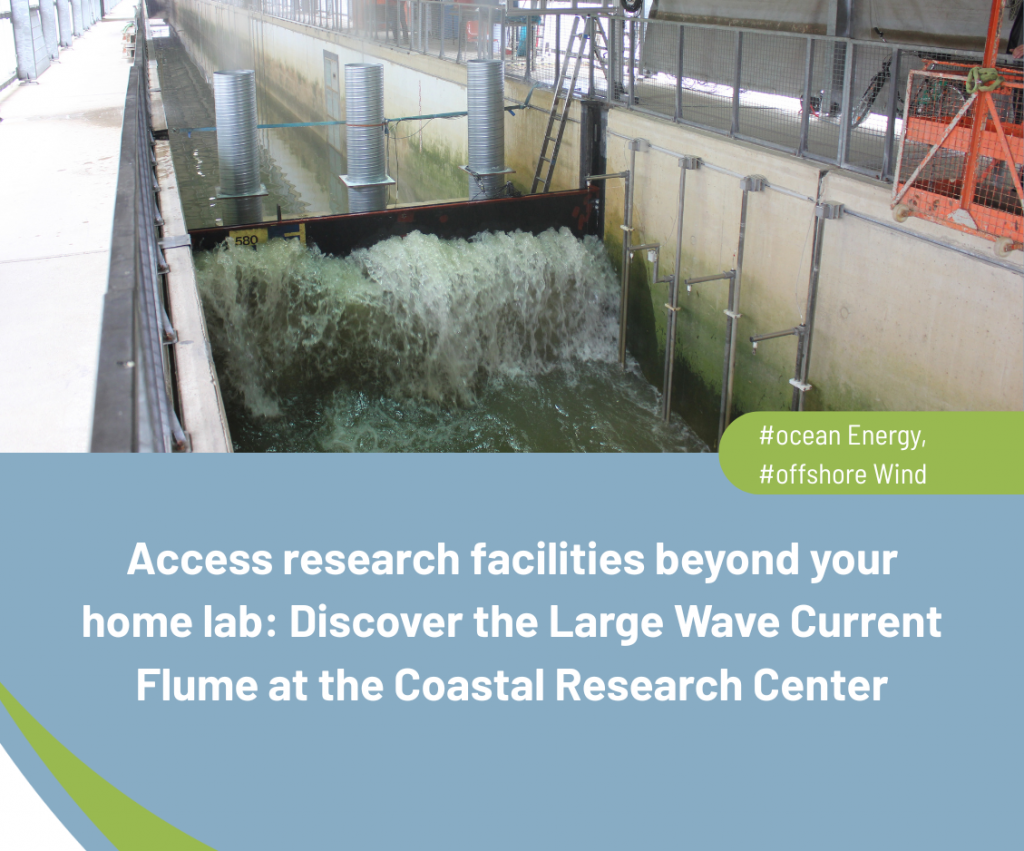
The Coastal Research Center FZK (Germany) is a research infrastructure opening its doors to scientists through RISEnergy. It is designed for academic and industry researchers working on marine and coastal energy systems who are looking to move beyond the scale limitations of their home laboratories.
Common challenges in this field include the inability to test offshore structures at realistic scale, limited access to controlled wave–current conditions, or restricted opportunities to validate coastal and marine energy technologies before deployment. The Coastal Research Center FZK offers a way to overcome these bottlenecks by providing a large-scale experimental environment where researchers can test, validate and refine their concepts under controlled yet realistic marine conditions.
What is the Coastal Research Center FZK and the Large Wave Current Flume (GWK+)?
Located in Hannover, Germany, the Coastal Research Center FZK hosts one of Europe’s leading large-scale hydraulic research facilities: the Large Wave Current Flume (GWK+).
With a length of around 300m, a width of 5m and a depth of 7m, the GWK+ is one of the largest flumes in the world and helps researchers by developing waves and their interaction with a wide variety of structures. Recently renovated, the facility includes a wave maker, a current generation system and a deep section. These new features allow for the generation of waves and sea states with heights up to three metres while simultaneously absorbing reflected waves.
In addition, currents with flow rates of up to 20,000 litres per second can be generated simultaneously and entire tidal cycles, including flow reversal and water level change, can be simulated without interrupting the test. The new staggered deep section (length / depth: 28 meters / 2 meters & 8 meters / 6 meters) allows the installation of sea floors flush to the rest of the flume bottom and a realistic embedding of offshore foundation structures in the ground.
What researchers typically walk away with
Researchers accessing the Coastal Research Center FZK through RISEnergy typically leave with:
- Validated offshore and coastal system designs under realistic hydrodynamic conditions
- High-quality experimental data for model calibration and technology optimisation
- Deeper understanding of wave–structure interaction and sediment processes
- Increased confidence to advance technologies towards demonstration and deployment
How access works through RISEnergy
Access to the Coastal Research Center FZK is provided through the Transnational Access (TA) programme of RISEnergy, which enables researchers to use world-class research infrastructures located outside their home country. The programme is open to both academic and industry researchers, at different career stages, whose main affiliation is in a country other than the one hosting the infrastructure.
Researchers apply with a project proposal and, if selected, benefit from:
- Free access to the infrastructure and its services
- Scientific and technical support from the hosting facility
Prepare and submit your proposal through the next RISEnergy Transnational Access call, opening in March 2026!
Explore more!
To help you assess whether the Coastal Research Center FZK is a fit for your research, explore additional materials:
RISEnergy also offers access to a wide range of research infrastructures supporting work in biofuels, concentrated solar power (CSP), energy storage, hydrogen, ICT, integrated grids, materials, photovoltaics and more. Explore the full RISEnergy research infrastructure catalogue here: