
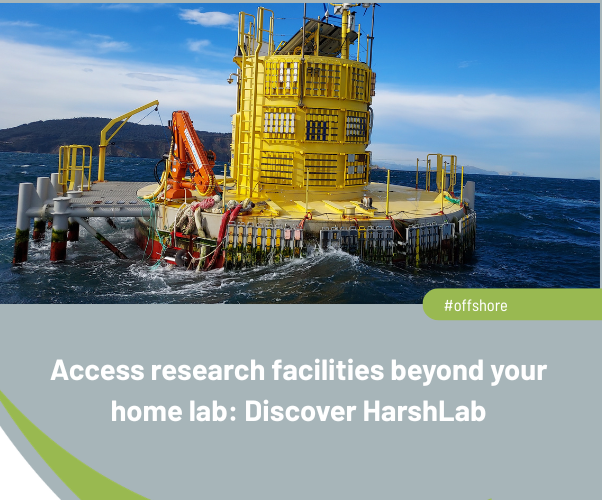
HarshLab is a floating offshore laboratory owned by Tecnalia that enables the testing and validation of materials and equipment under real offshore conditions. Thanks to RISEnergy, researchers across Europe can apply for free access to advance their work on offshore energy technologies, materials and components.
A common challenge in offshore energy research is the difficulty of testing technologies under realistic marine conditions. A standard laboratory and nearshore environments cannot replicate the combined effects of waves, wind, corrosion, biofouling, and the dynamic behaviour of floating structures. The limited access to open sea environments makes it difficult to generate reliable performance data for components such as coatings, sensors, and cables. TECNALIA-HarshLab offers a way to overcome these bottlenecks by providing a real offshore testing environment where researchers can test, validate and refine their technologies under real environmental conditions.
What is TECNALIA–HarshLab?
Operated by TECNALIA, HarshLab is an offshore floating laboratory moored at the Biscay Marine Platform (BiMEP) in 2018, 1.6 miles off the Basque coast in the Bay of Biscay in Spain. Located in an open sea area exposed to strong North Atlantic winds and waves, it enables testing of materials, components and equipment in atmospheric, splash and immersion zones under real offshore conditions.
HarshLab supports the testing of anticorrosion and antifouling coatings, advanced materials, sensors and strain gauges, floating photovoltaic systems, and offshore components such as connectors and umbilical cables. The platform is equipped with dedicated hull connectors for cable testing and supported by a remotely operated vehicle (ROV) for underwater inspection and experimentation. It also provides access to metocean data from an onboard meteorological station and nearby oceanographic buoy. By combining offshore experimentation with TECNALIA’s onshore laboratories, HarshLab enables the generation of robust real-world performance data and supports a deeper understanding of material behaviour, performance and degradation in a real-sea environment.
Researchers also benefit from the operational expertise of the TECNALIA team. The dedicated trained offshore team has already supported multiple EU and private projects since 2018 and brings the necessary expertise to make the needed decisions, install customer’s prototypes on board, liaise with local boat services and with BiMEP personnel.
What researchers typically walk away with
Researchers accessing HarshLab through RISEnergy typically leave with:
- Validated performance of materials, coatings, and devices
- High-quality data on corrosion, ageing, and structural behaviour in marine environments
- Improved understanding of how technologies respond to combined environmental stress factors
- Increased confidence to advance offshore energy solutions towards demonstration and deployment
How access works through RISEnergy
Access to TECNALIA–HarshLab is provided through the Transnational Access (TA) programme of RISEnergy, which enables researchers to use world-class research infrastructures located outside their home country. The programme is open to both academic and industry researchers, at different career stages, whose main affiliation is in a country other than the one hosting the infrastructure.
Researchers apply with a project proposal and, if selected, benefit from:
- Free access to the infrastructure and its services
- Scientific and technical support from the hosting facility
Prepare and submit your proposal through the next RISEnergy Transnational Access call, opening in September 2026.
Watch the HarshLab video to see the infastructure in action:
Explore more!
To help you assess whether the HarshLab is a fit for your research, explore additional materials:
RISEnergy also offers access to a wide range of research infrastructures supporting work in ocean energy, biofuels, concentrated solar power (CSP), energy storage, hydrogen, ICT, integrated grids, materials, photovoltaics and more. Explore the full RISEnergy research infrastructure catalogue: